Seduced by the Lie: The Psychological Power of Narrators Who Cannot Be Trusted
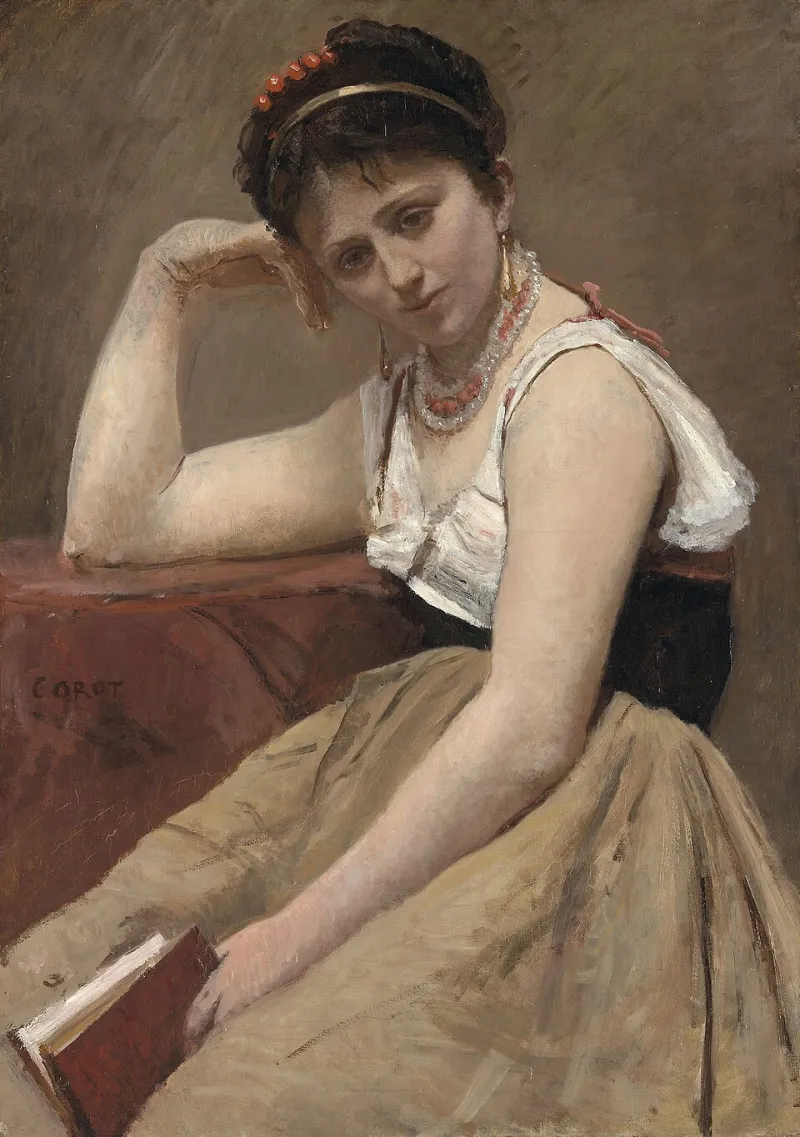
Photo: Jean-Baptiste Camille Corot, Public domain, via Wikimedia Commons
There is a particular kind of reading experience that begins with comfort and ends in vertigo. The narrator's voice feels intimate, even confessional. The reader leans in. Trust accumulates, sentence by sentence, until the moment of revelation arrives — and everything that came before must be reread through an entirely different lens. This is the architecture of the unreliable narrator, and it represents one of contemporary fiction's most powerful and enduring techniques.
At Immersion Press, we believe literature's highest calling is to pull readers beneath the surface of ordinary perception. Few narrative devices accomplish this as completely as the deliberate manipulation of first-person — or even close third-person — perspective. When an author constructs a narrator who distorts, omits, or actively deceives, the reader does not merely observe a story. They become implicated in it.
The Mechanics of Manufactured Trust
Before a narrator can betray a reader, that narrator must first earn their confidence. This is the stage that separates skillfully constructed unreliable narration from mere plot trickery. Authors who excel at this form spend considerable time establishing what literary scholars sometimes call a "zone of intimacy" — a narrative space in which the reader feels they have been granted privileged access to a consciousness.
Gillian Flynn's Gone Girl (2012) remains the defining American example of this principle in action. Nick Dunne narrates with the self-deprecating charm of a man who seems incapable of sustained deception precisely because he is so transparently flawed. Flynn understood that a narrator who admits small weaknesses acquires enormous credibility for the larger claims they make. Readers forgive, and in forgiving, they lower their defenses. Amy Dunne's alternating chapters function differently — her diary voice performs sincerity rather than embodying it — but both narrators exploit the same fundamental human tendency: we trust what sounds like confession.
Susanna Clarke's Piranesi (2020) operates through a wholly different mechanism. Its narrator is not calculating; he is genuinely, heartbreakingly unaware of the truth of his own circumstances. The unreliability here emerges from cognitive damage and manufactured memory rather than intentional misdirection. Clarke forces readers into the uncomfortable position of simultaneously inhabiting a perspective and recognizing its limitations — a kind of double consciousness that is both disorienting and deeply moving. The reader knows more than Piranesi does, yet cannot escape the gravitational pull of his wonder.
Why Readers Crave the Betrayal
The obvious question is why anyone would willingly submit to being misled. The answer, psychologists and narrative theorists suggest, lies in the distinction between the discomfort of real-world deception and the safety of fictional betrayal.
When a trusted narrator reveals their unreliability, the reader experiences a controlled version of epistemological crisis — the unsettling recognition that what they believed to be true was constructed rather than given. In ordinary life, this experience is genuinely threatening. Within the bounds of a novel, it becomes a form of intellectual pleasure. The reader gets to feel the cognitive shock of having their worldview dismantled while remaining entirely safe.
There is also something deeply satisfying about retrospective rereading. Once the deception is revealed, every prior passage becomes a puzzle. Readers return to the beginning armed with new knowledge, and the text rewards them with the hidden architecture of the lie — the carefully placed ambiguities, the telling omissions, the moments where the narrator's mask slipped just slightly enough to be noticed in retrospect but not in the moment. This rereadability is one reason unreliable narrator novels tend to generate sustained cultural conversation long after publication.
Crafting the Seduction: What Authors Consider
Authors who work extensively with unreliable narration consistently describe the process as one of sustained, disciplined restraint. The temptation to reveal the narrator's unreliability too early — to give the reader a knowing wink — is apparently significant. Resisting that temptation requires a commitment to the narrator's internal logic that borders on method acting.
The critical craft challenge is consistency of voice. A narrator who is concealing something must conceal it in a way that feels organic to their established personality. If the deception requires the narrator to behave in ways that contradict their established characterization, readers will sense the manipulation before the author intends them to. The lie must be, in some essential way, true to the liar.
Equally important is the question of what readers are permitted to know versus what the narrator knows. Some of the most sophisticated examples of the form — Patricia Highsmith's Ripley novels, for instance — place readers inside a consciousness that is fully aware of its own criminality. The unreliability is not cognitive but moral. Readers are not deceived about facts; they are seduced into sympathy with a perspective they would, outside the novel, find reprehensible. This is perhaps the most audacious form of the technique, because it implicates the reader most directly.
The Shift That Changes Everything
Every successful unreliable narrator narrative contains what might be called a fulcrum moment — the point at which the reader's understanding of the entire preceding text is forcibly revised. The quality of this moment is what separates the merely clever from the genuinely profound.
In lesser examples, the revelation functions primarily as a plot twist — a surprise that produces a momentary gasp before the story continues toward resolution. In the finest examples, the revelation recontextualizes not just the plot but the reader's relationship to the act of reading itself. Piranesi's central revelation does not simply explain the mystery of the House; it transforms the reader's understanding of consciousness, memory, and the stories we construct to make sense of our circumstances. The novel becomes, retroactively, about something far larger than it appeared.
This capacity to expand in retrospect is the hallmark of unreliable narration done at the highest level. The story the reader thought they were reading turns out to have been a surface concealing a deeper story — which is, when one considers it, precisely what immersive literature aspires to accomplish in every form it takes.
Reading Under False Certainty
Perhaps the most honest observation about unreliable narration is that it makes explicit what all fiction does implicitly. Every narrator — reliable or otherwise — is a constructed perspective, a selective and inevitably distorted window onto imagined events. The unreliable narrator simply makes this condition visible, forcing readers to confront the degree to which narrative itself is an act of persuasion.
For readers willing to surrender to that discomfort, the experience is among the most fully immersive that fiction can offer. You are not simply reading about a character who cannot be trusted. You are discovering, in real time, the limits of your own credulity — and finding that those limits are considerably more permeable than you had previously supposed.