Beyond the Printed Page: How Experimental Writers Are Rebuilding the Novel in Virtual Space
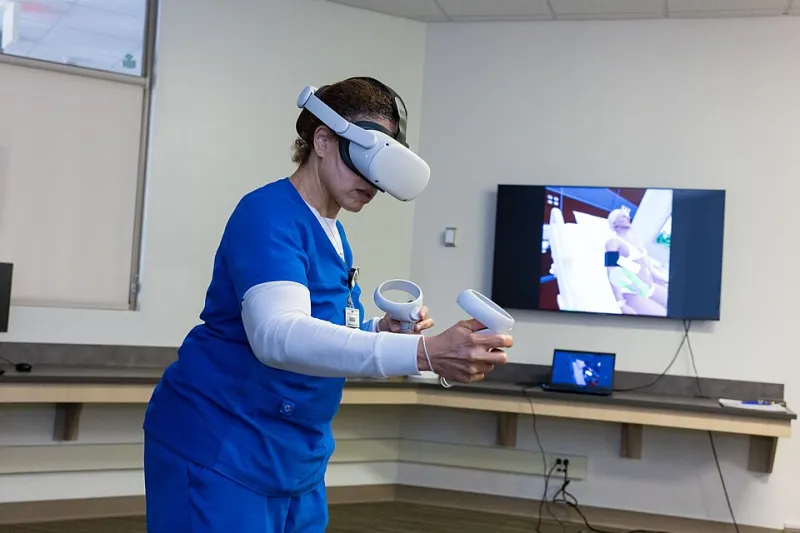
Photo: waketechcc, CC0, via Wikimedia Commons
For centuries, the novel has operated under a quietly tyrannical assumption: that story lives between covers, that a reader's role is fundamentally passive, and that the page is the natural and sufficient home of literary experience. In 2024, that assumption is under more sustained pressure than at any previous moment in the history of the form. The writers and publishers applying that pressure are not, for the most part, working inside the major commercial publishing houses. They are operating at the experimental margins — precisely where the most consequential literary innovations have always originated.
At Immersion Press, we have long maintained that the most adventurous storytelling refuses to be confined by medium. The emergence of virtual reality narratives, interactive fiction platforms, and hybrid literary apps represents not a threat to serious literature but its logical evolution — a set of new instruments for the oldest and most essential human activity: pulling someone beneath the surface of ordinary experience and into a world that exists only in the shared space between creator and audience.
The Limitations That Inspired a Movement
To understand why experimental writers are migrating toward new formats, it is useful to first understand what those writers find insufficient about the printed page. The grievance is not aesthetic — most of the authors working in immersive digital formats are also devoted readers of traditional fiction. The concern is structural.
Conventional prose narration is, by its nature, linear and unidirectional. Even the most formally adventurous print novels — those that fragment chronology, multiply perspectives, or incorporate visual elements — ultimately deliver a fixed sequence of words that every reader encounters in essentially the same order. The reader's agency is limited to interpretation. They cannot alter the text's direction, inhabit its spaces, or make choices that generate different narrative outcomes.
For a certain category of story — particularly those concerned with questions of agency, consequence, and the subjective construction of reality — this limitation is not merely technical. It is thematic. A novel about the nature of choice that does not permit the reader to choose is, in some fundamental sense, arguing against its own premise.
Interactive Fiction: The Oldest New Form
Interactive fiction has a longer history than its current moment of resurgence might suggest. Text adventure games of the late 1970s and early 1980s — Zork, Colossal Cave Adventure — were, in their own way, experimental literature: narrative experiences in which the reader's input shaped the unfolding of the story. What has changed in 2024 is the sophistication of the tools available and the seriousness with which literary writers are engaging with the form.
Platforms such as Inkle Studios' inklewriter and the open-source Twine have made branching narrative construction accessible to writers without programming backgrounds. The results range from genre entertainment to work of genuine literary ambition. Emily Short, one of the most respected figures in contemporary interactive fiction, has spent years demonstrating that the form is capable of exploring psychological and emotional complexity that rivals — and in some respects exceeds — what traditional prose can accomplish. Her work has influenced a generation of writers who might otherwise never have considered the form.
For American indie publishers, interactive fiction represents a particularly interesting opportunity. Distribution costs are negligible compared to print, and the audience — particularly among readers aged eighteen to thirty-five who grew up with narrative video games — is substantial and largely underserved by literary publishers who have been slow to recognize them.
Virtual Reality and the Dissolution of the Frame
If interactive fiction expands reader agency within a textual framework, virtual reality narratives go considerably further — eliminating the frame itself. In a VR literary experience, the reader does not observe a described environment; they inhabit one. The spatial and embodied dimensions of storytelling, which prose can only approximate through language, become literal.
The practical challenges of VR narrative are significant. Producing a high-quality virtual reality experience requires resources that most independent literary publishers do not possess. The hardware barrier — the requirement that readers own a VR headset — substantially limits the potential audience. And the grammar of VR storytelling is still being invented; the techniques that make prose fiction compelling do not translate directly into three-dimensional space.
Despite these obstacles, a number of small studios and experimental collectives have produced VR literary works of genuine distinction. Wolves in the Walls, developed by Fable Studio and based on Neil Gaiman's illustrated story, demonstrated that VR could sustain genuine emotional intimacy rather than merely spectacular immersion. The project's approach — centering the experience on a single child character who develops a relationship with the reader over multiple sessions — suggested that VR's most powerful literary application may not be spectacle but presence.
Several independent American authors are currently developing original VR narratives outside the commercial game industry entirely. These projects tend to be modest in technical scope but ambitious in their literary intentions, prioritizing narrative and emotional design over visual extravagance. The constraint, several of these authors have noted, is generative: when you cannot rely on graphical fidelity to create immersion, you are forced back to the fundamental tools of storytelling — character, voice, consequence.
Apps, Serialization, and the Pocket Novel
Between the relative accessibility of interactive fiction and the considerable demands of VR lies a rapidly growing middle category: literary apps designed specifically for mobile devices. Platforms such as Serial Box (now Realm), Chapters, and a constellation of smaller independent apps have developed reading experiences tailored to the specific conditions of mobile engagement — shorter episodes, serialized release schedules, and in some cases light interactive elements.
The serialized model deserves particular attention. American readers are culturally primed for serialized narrative through decades of television, podcast storytelling, and prestige drama. Literary fiction has been slower to embrace serialization than genre fiction, but experimental publishers are beginning to recognize its potential. A story released in weekly or monthly installments generates sustained audience engagement, community discussion, and the kind of anticipatory investment that single-volume publication rarely achieves.
Some of the most interesting work currently happening in this space involves authors who are designing their narratives specifically around the serialized app format rather than adapting existing work. The structural implications are significant: stories designed for episodic mobile consumption have different pacing requirements, different chapter architecture, and different relationships with their readers than novels conceived as complete objects.
A Curated Starting Point for 2024
For readers interested in exploring immersive fiction beyond the traditional codex, the current landscape offers several compelling entry points. Twine-based interactive fiction is freely available through the Interactive Fiction Database (ifdb.org), which catalogs thousands of works across every conceivable genre and level of literary ambition. For VR-adjacent experiences, the Oculus store and Steam both carry narrative experiences that lean toward the literary end of the spectrum. And for serialized mobile fiction, Realm's catalog represents one of the more curated selections currently available to American readers.
The printed novel is not going anywhere. Its particular form of immersion — the sustained, solitary, language-mediated encounter with another consciousness — remains irreplaceable and will remain so. But the writers currently building stories in virtual space, in branching apps, and in serialized mobile formats are not replacing that experience. They are expanding the territory of what immersive literature can claim as its own. For readers willing to follow them into those new spaces, the rewards are considerable — and the ground beneath their feet is, in the most productive sense possible, entirely uncertain.