Fractured Testimony: How Experimental Novelists Are Turning True Crime's Obsession With Evidence Against Memory Itself
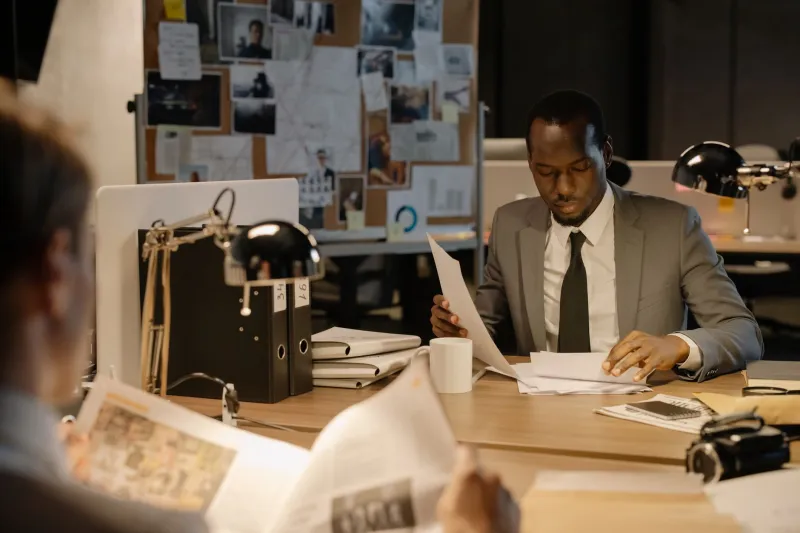
There is something deeply seductive about the architecture of true crime. Its premise is fundamentally reassuring: events happened, witnesses observed them, and through the disciplined accumulation of evidence, a coherent account will eventually emerge. The genre's immense popularity in American culture—from Serial to The Jinx to the avalanche of Netflix docuseries that have colonized the past decade—rests on this implicit promise. Somewhere beneath the noise of competing statements and contradictory timelines, a stable truth waits to be excavated.
Experimental fiction has begun to steal true crime's tools in order to demolish that promise entirely.
A growing cohort of contemporary novelists is borrowing the investigative genre's formal vocabulary—case files, transcribed interviews, police reports, redacted documents, timestamped witness accounts—and deploying it toward a radically different end. Where true crime marshals evidence to approach certainty, these writers accumulate it to produce vertigo. The detective story, turned inside out, becomes something far more unsettling: an inquiry whose only confirmed finding is the fundamental unreliability of the human mind.
The Evidence That Undermines Itself
Consider what true crime's documentary apparatus actually communicates when lifted from its native context. A transcript implies verbatim accuracy, yet every experienced reader knows that speech is edited, that ellipses conceal, that the act of transcription is itself an act of interpretation. A police photograph presents itself as objective record, yet framing, lighting, and sequence all impose meaning. A timeline suggests causality simply through chronological arrangement.
Experimental novelists have recognized that these forms carry enormous rhetorical authority precisely because readers have been conditioned, through decades of true crime consumption, to grant them evidential weight. Introduce a document that looks like a deposition, and readers instinctively calibrate toward belief. Then introduce a second document that contradicts the first—equally formatted, equally authoritative in appearance—and something interesting happens. The reader does not simply note a discrepancy. The reader begins to feel epistemologically unsafe.
This is the central maneuver. The apparatus of investigation, designed to produce resolution, is repurposed to produce irresolution. The genre's promise is invoked and then, methodically, revoked.
Competing Testimonies and the Architecture of Doubt
The technique of placing contradictory witness accounts in direct structural tension is perhaps the most immediately legible borrowing from true crime methodology. In a conventional thriller, competing testimonies exist to be resolved—one narrator is lying, another is mistaken, and the detective's task is disambiguation. In experimental fiction working this vein, no such disambiguation arrives.
What the reader receives instead is an education in how memory actually functions. Cognitive science has established, with considerable rigor, that human memory is reconstructive rather than reproductive. We do not retrieve stored recordings; we rebuild events from fragments, filling gaps with inference, expectation, and emotional coloring. Each reconstruction subtly alters the stored trace, meaning that the act of remembering is also, inevitably, an act of revision.
Fiction that presents multiple, irreconcilable accounts of the same event is not, therefore, presenting a puzzle with a hidden solution. It is presenting an accurate model of how several minds, each operating in good faith, can produce genuinely incompatible versions of shared experience. The investigation goes cold not because the evidence is insufficient but because the nature of memory makes definitive reconstruction impossible.
Fragmented Timelines as Forensic Disorientation
True crime's chronological reconstruction—establishing where a subject was at a precise moment, tracing the sequence of decisions that led to a particular outcome—carries an implicit philosophical claim: that events have a fixed order and that identifying that order illuminates causation. Experimental fiction exploits this assumption by presenting timelines that refuse to stabilize.
Fragmented chronology, of course, is hardly new to literary fiction. What distinguishes the current approach is the specific texture of the fragmentation. These novels do not simply shuffle chapters; they present their disorder as evidentiary, as if the broken sequence were itself a document recovered from an unreliable archive. Dates contradict one another. A scene described as occurring in autumn is later placed in spring. A character recalls an event that, according to another section, has not yet happened.
The effect is not confusion for its own sake. It is a formal argument about the nature of traumatic and ordinary memory alike—the way significant events are experienced non-linearly, revisited obsessively, and gradually distorted by the emotional weight we bring to each successive recollection. The fragmented timeline does not represent a failure of narrative organization. It represents an honest account of how the past actually inhabits consciousness.
Documentary Inserts and the Illusion of the Stable Record
Perhaps the most formally adventurous technique in this emerging mode is the incorporation of fabricated documentary material—invented newspaper clippings, forged institutional letters, mock social media archives, simulated medical records. These inserts perform objectivity. They arrive in a different font, a different register, a different apparent voice, and they seem to exist outside the subjectivity of any single narrator.
Yet the experimental novelist's insertion of such documents is itself an act of authorial control, and readers who attend carefully will notice that the documents are no more reliable than the voices surrounding them. The newspaper account contains the journalist's bias. The medical record reflects the clinician's interpretive framework. The letter was written by someone with an agenda. Every ostensibly neutral document, examined closely, reveals the perspective of its maker.
This is true crime's deepest lesson, applied with a literary sensibility: the archive is never neutral. Every piece of evidence was produced by a human being with limited perception, particular interests, and the cognitive apparatus of a species whose memory is fundamentally reconstructive. The documentary insert in experimental fiction does not anchor the narrative; it extends the instability into territory the reader assumed was solid ground.
The Reader as Investigator, the Investigation as Mirror
What these novels ultimately accomplish—and what distinguishes them from mere formal experimentation—is a transfer of epistemological responsibility onto the reader. True crime positions its audience as passive beneficiaries of the investigator's labor; the detective does the work, and the audience receives the conclusion. Experimental fiction working in this mode refuses that comfort.
The reader must weigh testimonies, assess documents, track chronological inconsistencies, and arrive at judgments that the text will not ratify. And in performing this labor, the reader is inevitably confronted with a disquieting question: by what standard am I evaluating these competing accounts? What assumptions about memory, perception, and narrative coherence am I bringing to this investigation?
The answer, almost always, is that the reader is applying the same fallible cognitive apparatus that produced the unreliable testimonies in the first place. The investigation turns inward. The witness under examination becomes the reader's own confidence in perception.
This is where the immersive potential of the form reaches its full depth. The reader is not merely observing a story about the unreliability of memory. The reader is experiencing it—caught in the same reconstructive, gap-filling, inference-driven process that makes human testimony so persistently, fascinatingly, and sometimes tragically imprecise.
True crime promises answers. Experimental fiction, borrowing its methods with considerable sophistication, delivers something more valuable: a visceral encounter with the question.