Gathering in the Dark: America's Secret Reading Circles and the Loneliness at the Heart of Experimental Literature
The invitation arrives without a subject line. A mutual acquaintance has passed along your email address to someone you have never met, with a note that you might be "the kind of reader" a particular group is looking for. The message that follows is brief, precise, and notably free of the usual social courtesies. There is a meeting. There is a text — usually something formally radical, recently published by an independent press, not widely reviewed. Attendance is not mandatory but attendance is expected. You are asked not to share the group's name, such as it is, or its location.
This is not an unusual introduction for the growing number of underground reading communities devoted to experimental and avant-garde fiction operating across the United States. From unlisted Discord servers with membership requirements to book clubs convening in borrowed apartments in cities like Austin, Philadelphia, and Seattle, these groups have developed a culture of deliberate obscurity that is worth examining — not as eccentricity, but as symptom.
The Shape of the Underground
Estimating the scale of this phenomenon is, by definition, difficult. Groups that resist visibility also resist counting. But conversations with participants across a dozen states reveal a landscape that is broader and more varied than the literary community's public face might suggest.
Some communities are digital-first. A Discord server operating under a deliberately unremarkable name — one participant described it as being named after a minor character in a Blanchot text, which functioned as a kind of shibboleth — maintains a membership of roughly two hundred readers spread across the country. Admission requires a written response to a short passage of experimental prose. The response, one moderator explained in a brief exchange, is evaluated less for its critical sophistication than for what it reveals about the applicant's tolerance for ambiguity. "We're not looking for the smartest reader," she wrote. "We're looking for the reader who can sit with not knowing."
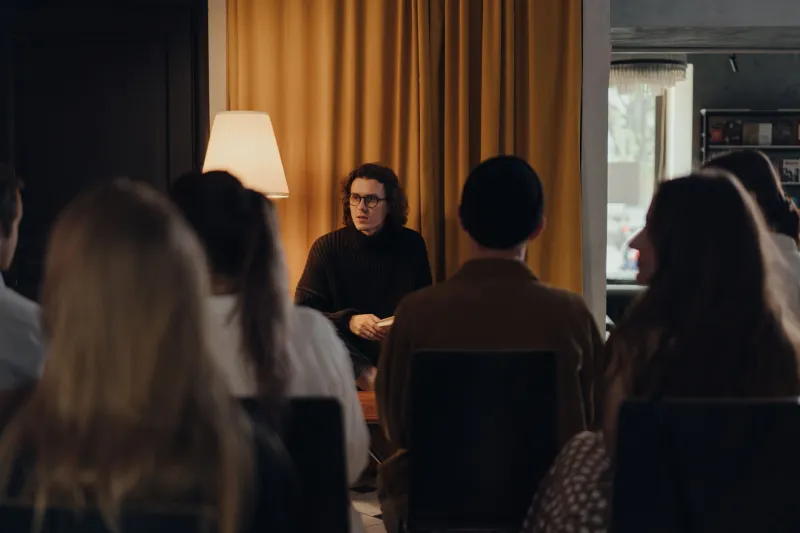
Other communities are emphatically physical. In Chicago, a group that has met monthly for nearly four years has no official name, no social media presence, and no fixed venue. It moves between members' homes, occasionally occupying the back room of an independent bookstore after closing hours. Membership is capped at twelve. The waiting list, maintained informally by word of mouth, is longer than the group itself.
What They Are Seeking
The participants who agreed to speak for this piece — almost all on condition of anonymity or under first names only — offered accounts of their motivations that converged on a handful of recurring themes. Foremost among them: the experience of having no one in their ordinary social lives who reads the way they read.
"I have friends who read a lot," says a woman named Theresa, a graphic designer in her late thirties who participates in one of the Chicago groups. "They read literary fiction. Good literary fiction. But when I try to talk about the books that actually matter to me — the ones that break something open — there's nothing there. They're polite. They're not interested. I've stopped trying."
This description of social isolation around reading practice came up repeatedly. Participants described the experience of loving experimental fiction as a kind of loneliness with no socially legible name — not the loneliness of grief or estrangement, but a quieter disconnection from the assumption that literature is a shared language.
"Book clubs exist for a reason," says James, a software engineer in his mid-forties who participates in a private online group. "People want to talk about what they've read. But most book clubs are built around consensus. Around accessibility. Around the idea that everyone in the room should be able to have an opinion. Experimental fiction doesn't work that way. It resists consensus. So you need a different kind of room."
The Exclusivity Question
The deliberate obscurity of these communities raises a question that their participants are not always comfortable confronting: whether the insularity of experimental fiction's readership is a natural consequence of the form's difficulty, or whether it is actively reproduced — and whether that reproduction constitutes meaningful counterculture or simple gatekeeping.
The distinction matters. A community that gathers in the shadows because it has found no hospitable public space is a different phenomenon from one that cultivates its own inaccessibility as a form of identity. Both exist within the underground reading culture, sometimes within the same group.
Dr. Felicia Tran, a sociologist at the University of Texas at Austin who studies niche literary communities, sees both dynamics at work. "There is genuine marginalization," she says. "Experimental fiction does not have the institutional support structures that genre fiction or mainstream literary fiction enjoy. The MFA system engages with it selectively. Major review outlets cover it inconsistently. People who love this work often have no mainstream venue for that love."
But Tran also notes a countervailing tendency. "Some of these communities have internalized exclusivity as a value in itself. The difficulty of the literature becomes a proxy for the difficulty of entry into the community. And at that point, you're not really talking about literature anymore. You're talking about social sorting."
Technology as Enabler, Technology as Limit
The digital infrastructure of these communities is worth noting, not least because it represents a significant departure from the physical, place-based literary underground of earlier decades. Private Discord servers, encrypted group chats, and invitation-only newsletters have made it possible for experimental fiction readers to find one another across geographic distances that would previously have enforced total isolation.
But technology has also introduced new tensions. Several participants noted that the asynchronous nature of digital communication sits uneasily with the kind of reading experimental fiction demands. "The whole point of reading something genuinely difficult is that it changes how you think," says James. "And you need time with that. You need silence with that. Discord moves fast. It rewards the quick take. That's not what this literature is for."
The groups that appear to sustain the deepest engagement are those that have found ways to impose slowness on digital platforms — limiting response windows, discouraging rapid-fire commentary, building in periods of deliberate silence between readings and discussions.
The Counterculture That Doesn't Know Its Name
What these communities ultimately reveal is not a conspiracy or a clique, but a genuine gap in American literary culture — a space where readers who have been formed by difficult, formally radical fiction have found that no existing institution adequately holds their experience.
Whether that gap is best addressed by bringing experimental fiction into broader public view, or by protecting the conditions of intensity and seriousness that these underground communities cultivate, is a question without a clean answer. The readers gathering in the dark are not, for the most part, interested in being discovered. They are interested in reading. And in finding, somewhere, someone else who reads the same way.
That is, in the end, a very old human need — dressed in the borrowed obscurity of a form that has always known how to disappear.